
How Do Large 3D Printing Services Transform Prototyping and Production?
Key Features
- Build envelopes extending to one cubic meter or more, enabling full-scale prototypes and tooling.
- High-throughput deposition technologies that compress production lead times from weeks to hours.
- Access to engineering-grade polymers, composites, and metals suited for functional, end-use applications.
- Hybrid workflows that combine additive printing with CNC finishing to achieve precise tolerances.
Have you ever imagined printing a car-sized part, a yacht mold, or an industrial tool in a matter of days instead of months? That vision is now a reality thanks to enterprise-scale 3D printing services, often referred to as large-format additive manufacturing (LFAM). With build envelopes exceeding one cubic meter and advanced material compatibility, these services redefine how industries prototype, tool, and even manufacture end-use parts.
Quick Answer
Large 3D printing services deliver meter-scale parts at unprecedented speed and scale using industrial polymers, composites, and metals. They are most valuable for full-size prototypes, tooling, molds, and low-volume end-use parts.
The global additive manufacturing market has expanded dramatically. Industry reports show that the market reached approximately $28 billion in 2024 and is projected to grow beyond $57 billion by 2028. This growth is not just driven by desktop or mid-size printers; large-format services represent one of the fastest-growing segments, offering companies the chance to build bigger, stronger, and faster than ever before. Surveys reveal that more than 70% of engineers increased their 3D printing usage in 2023 compared to 2022, underscoring the accelerating adoption across industries.
What Defines a Large 3D Printing Service?
Large-scale 3D printing generally refers to services capable of printing single-piece parts at least one meter in one axis, or volumes of roughly one cubic meter. Platforms like the BigRep ONE, Stratasys F900, and Massivit 5000 have redefined the boundaries of what can be built. The BigRep ONE offers a build volume of approximately one cubic meter, allowing for furniture-scale prototypes or industrial housings.
The Stratasys F900, while slightly smaller in raw dimensions, provides unmatched material versatility with aerospace-approved polymers. The Massivit 5000, on the other hand, specializes in speed, producing full-size components such as exhibition displays or transportation parts with curing gels.
Where Does Large 3D Printing Fit in the Product Lifecycle?
Large-format additive manufacturing fits across several stages:
- Concept models: Full-scale visualizations help stakeholders understand designs before investment.
- Functional prototypes: Engineers can test ergonomics, airflow, or load-bearing capacities with real-world materials.
- Production tooling and molds: Industries such as aerospace and marine use LFAM to create layup tools and molds quickly, enabling faster iteration.
- Low-volume end-use parts: For industries requiring limited runs of oversized parts, such as automotive covers, enclosures, or architectural components, large 3D printing provides a viable alternative to expensive molds.
How to Choose the Right Large 3D Printing Service Provider?
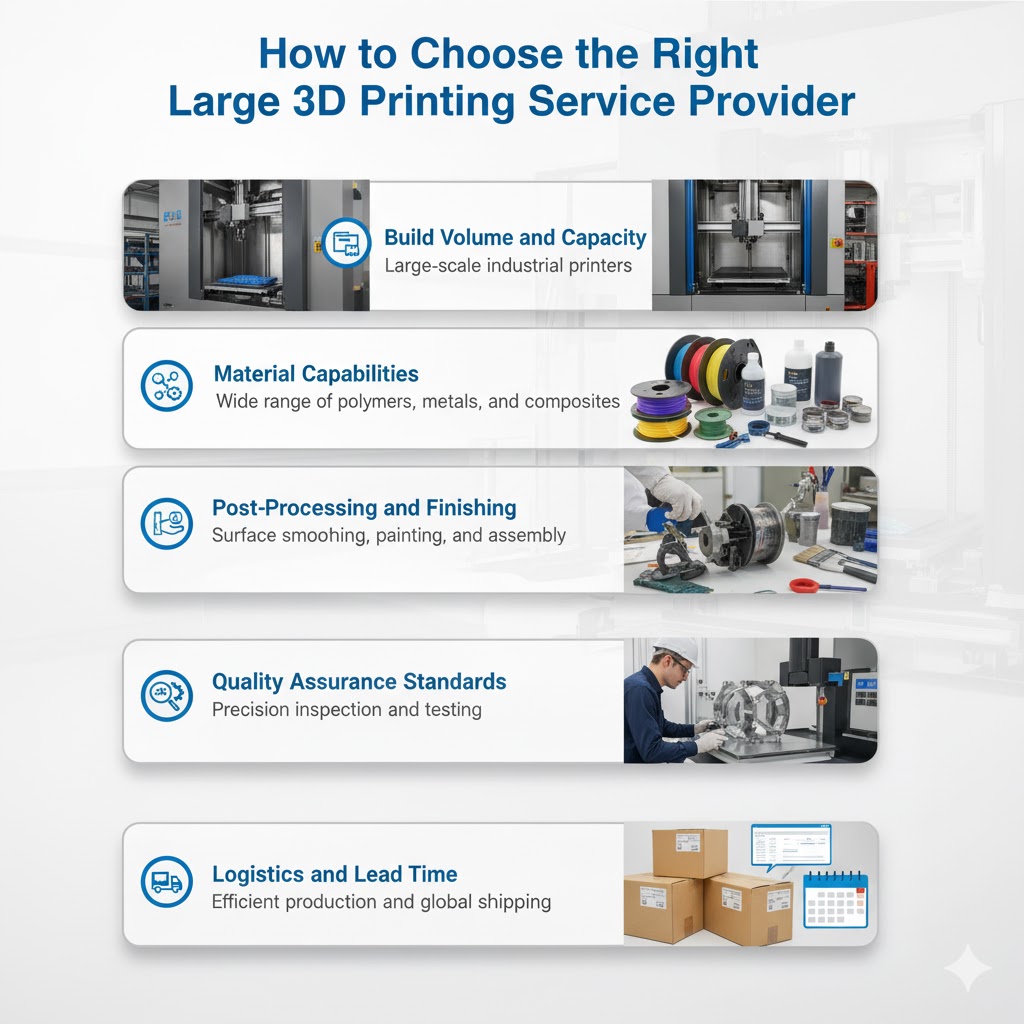
Selecting the right service provider is a critical step that determines the success of your project.
Build Volume and Capacity
The first factor to evaluate is the provider’s build envelope. Some printers can handle over one cubic meter in a single build, while others achieve larger dimensions through bonding. Understanding the provider’s maximum size capacity ensures your part can be produced efficiently without compromising strength or aesthetics.
Material Capabilities
Not all providers work with the same materials. Industrial applications often require high-performance polymers, composites, or even metals. A capable provider should offer engineering-grade materials like carbon-fiber reinforced plastics, ULTEM, or flame-retardant options to suit specialized needs.
Post-Processing and Finishing
Large 3D prints often require additional work to meet final specifications. CNC trimming, sanding, painting, or coating may be necessary for tolerances and surface quality. Providers that integrate finishing into their workflow offer a smoother path from prototype to end-use product.
Quality Assurance Standards
Inspection and certification are critical for industries like aerospace and automotive. Providers with advanced scanning, measurement, and first-article inspection capabilities ensure that parts meet compliance and customer standards.
Logistics and Lead Time
Oversized parts require careful handling and transportation. A reliable service provider should be transparent about lead times, packaging, and shipping methods to ensure parts arrive on schedule and in good condition.
How Do Large 3D Printing Technologies Differ?
Large-format 3D printing can be achieved through multiple technologies, each with its strengths and limitations. Understanding these methods helps businesses choose the best approach based on speed, 3D Printing cost, materials, and final application.
Fused Filament Fabrication (FFF) and Pellet Extrusion
These extrusion-based methods are the most common for large-format printing. Pellet-fed systems, in particular, allow for higher deposition rates, making them ideal for producing massive components quickly and at lower cost compared to filament spools.
Gel Dispensing Printing (GDP)
This technology uses fast-curing gel materials, which makes it possible to produce huge parts within hours instead of days. It is particularly well-suited for life-size models, display structures, and molds that require rapid turnaround.
Powder Bed Fusion (SLS and MJF)
While usually limited to smaller build sizes, powder bed systems produce excellent detail and surface quality. To achieve large parts, service providers often bond multiple sections together, making it a good choice for complex geometries and intricate features.
Directed Energy Deposition (DED) for Metals
DED is a method where metal powder or wire is melted using a laser or electron beam as it is deposited. It allows the production of larger metal structures than traditional powder bed systems, although precision may require additional machining.
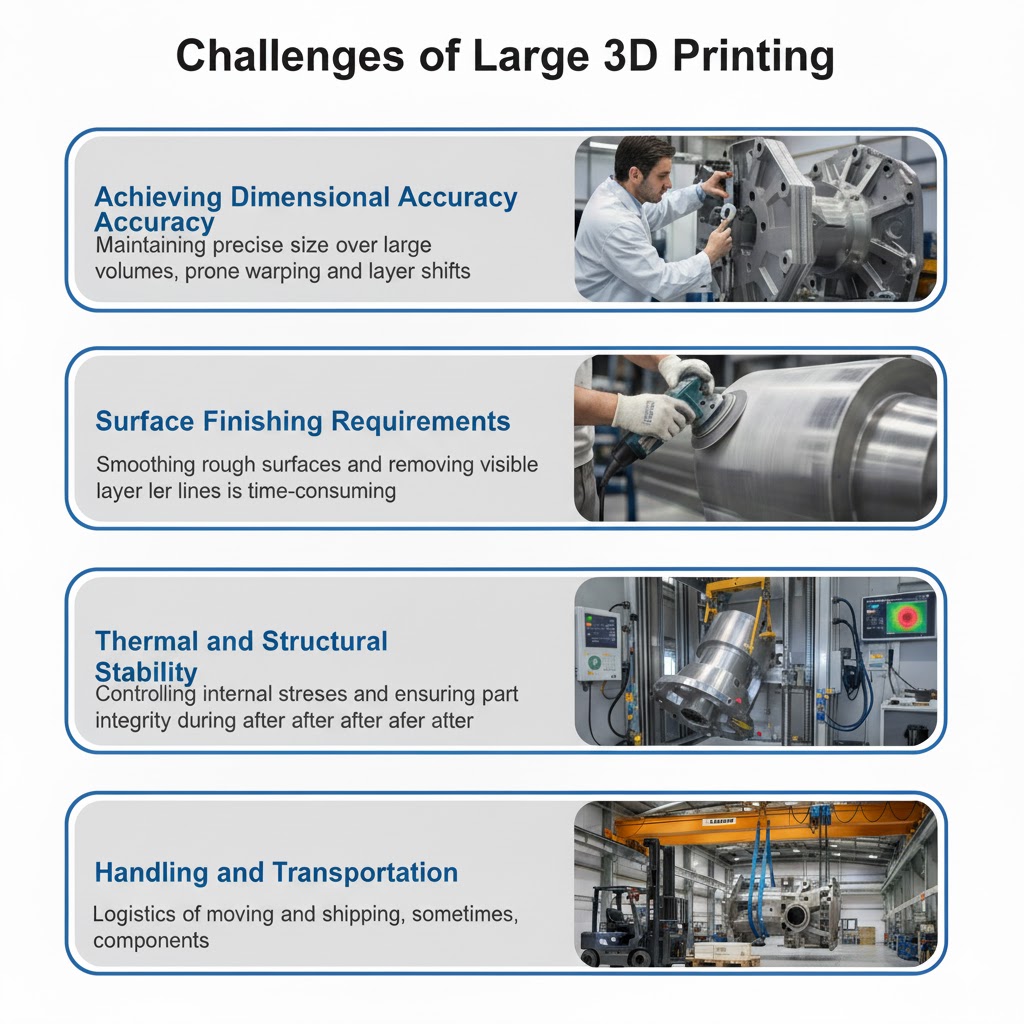
While large 3D printing brings speed, scale, and design freedom, it also comes with technical and operational hurdles. Understanding these challenges helps businesses plan better and avoid costly mistakes.
Achieving Dimensional Accuracy
Printing at a meter scale often leads to variations in tolerance. Without hybrid solutions like CNC trimming, it can be difficult to maintain precision across large surfaces.
Surface Finishing Requirements
Large parts rarely come off the printer with a final-ready finish. Post-processing such as sanding, machining, or coating is usually required, adding time and cost.
Thermal and Structural Stability
Large thermoplastic parts are more prone to warping, shrinkage, and internal stresses. Proper thermal management, annealing, and design strategies are necessary to reduce these risks.
Handling and Transportation
Oversized prints are challenging to package, store, and ship. Logistics become an integral part of the project, often requiring special arrangements and additional costs.
Which Industries Benefit Most From Large 3D Printing Services?
Large 3D printing is no longer limited to prototyping, it is transforming entire industries by offering full-scale production, rapid tooling, and custom design freedom.
Automotive Prototyping and Tooling
Car manufacturers use large-format printing for full-scale vehicle prototypes, fixtures, and assembly tools. This reduces development cycles and enables faster design validation.
Aerospace and Defense Applications
High-performance polymers and composites allow for lightweight cabin parts, ducts, and structural tools. Aerospace companies benefit from reduced lead times and cost savings in tooling.
Marine and Composite Manufacturing
Boat builders and marine manufacturers rely on large 3D printing for molds, plugs, and hull components. The technology enables the production of complex forms with shorter turnaround times.
Architecture and Construction
Architects use large 3D printing for façade panels, structural prototypes, and decorative elements. It helps in creating customized designs at a scale that was previously impractical.
Retail, Art, and Entertainment
From life-sized props to exhibition displays, large 3D printing provides quick and cost-effective solutions for creative industries, offering both speed and design flexibility.
What Does the Future Hold for Large 3D Printing Services?
The future of large-format 3D printing is promising. With advancements in robotic extrusion systems, integrated print-and-trim cells, and new materials, large parts will become even more cost-competitive. Emerging sectors such as construction, 3D printing, renewable energy, and defense are expected to drive further adoption.
Furthermore, as digital supply chains mature, large 3D printing services will integrate more closely with cloud-based design platforms, enabling distributed production where parts are printed closer to the point of use.
Final Words
Large 3D printing services are more than just a technological upgrade, they represent a shift in how industries approach scale, customization, and innovation. As global supply chains demand faster adaptability, the ability to create oversized, functional parts on demand will redefine competitive advantage. Companies that embrace these services today will not only cut costs and time but also position themselves at the forefront of a new era in digital manufacturing.

Hi, I’m Mark Stevens. I love exploring 3D printing and diving deep into slicer software. I spend my time testing slicer settings, comparing features, and sharing tips to help creators get smoother, faster, and more reliable prints. My goal is to make slicer tools easy to understand and use, whether you’re a beginner or a seasoned 3D-printing enthusiast.

