
3D Printing Resin Guide 2025: Types, Costs, Safety & Future Trends
Key Features
- High-resolution printing capability with smooth surfaces and fine details.
- Wide material range, including standard, tough, flexible, and castable resins.
- UV-curable chemistry enables precision and fast curing during the print process.
- Ideal for industries such as dental, jewelry, engineering prototypes, and miniatures.
Have you ever wondered why resin-based 3D prints look so much smoother and more detailed than their filament counterparts? The secret lies in 3D printing resin, a UV-curable photopolymer that has become the backbone of stereolithography (SLA), digital light processing (DLP), and LCD/MSLA printing technologies.
According to the Wohlers Report 2024, resin 3D printing has grown by more than 23% year-over-year, driven by industries like dental aligners, hearing aids, and jewelry casting. The global resin 3D printing materials market is expected to reach $3.6 billion by 2030, showing how crucial resins are for both professional and consumer-grade applications.
Quick Answer
3D printing resin is a UV-sensitive liquid polymer used in SLA, DLP, and LCD printers to create highly detailed parts. It offers superior surface finish and precision compared to filament.
Yet, the question remains: What exactly is 3D printing resin, how does it work, and is it worth the cost? This guide explores everything you need to know, from resin types and applications to safety, cost analysis, and future trends.
What Is 3D Printing Resin?

3D printing resin is a photopolymer material that solidifies when exposed to specific wavelengths of UV light. The process is called photopolymerization, where liquid resin is cured layer by layer to form solid parts. Unlike FDM filament, which extrudes melted plastic, resin prints rely on light precision for accuracy, making them ideal for applications demanding fine details.
How Does Resin 3D Printing Work?
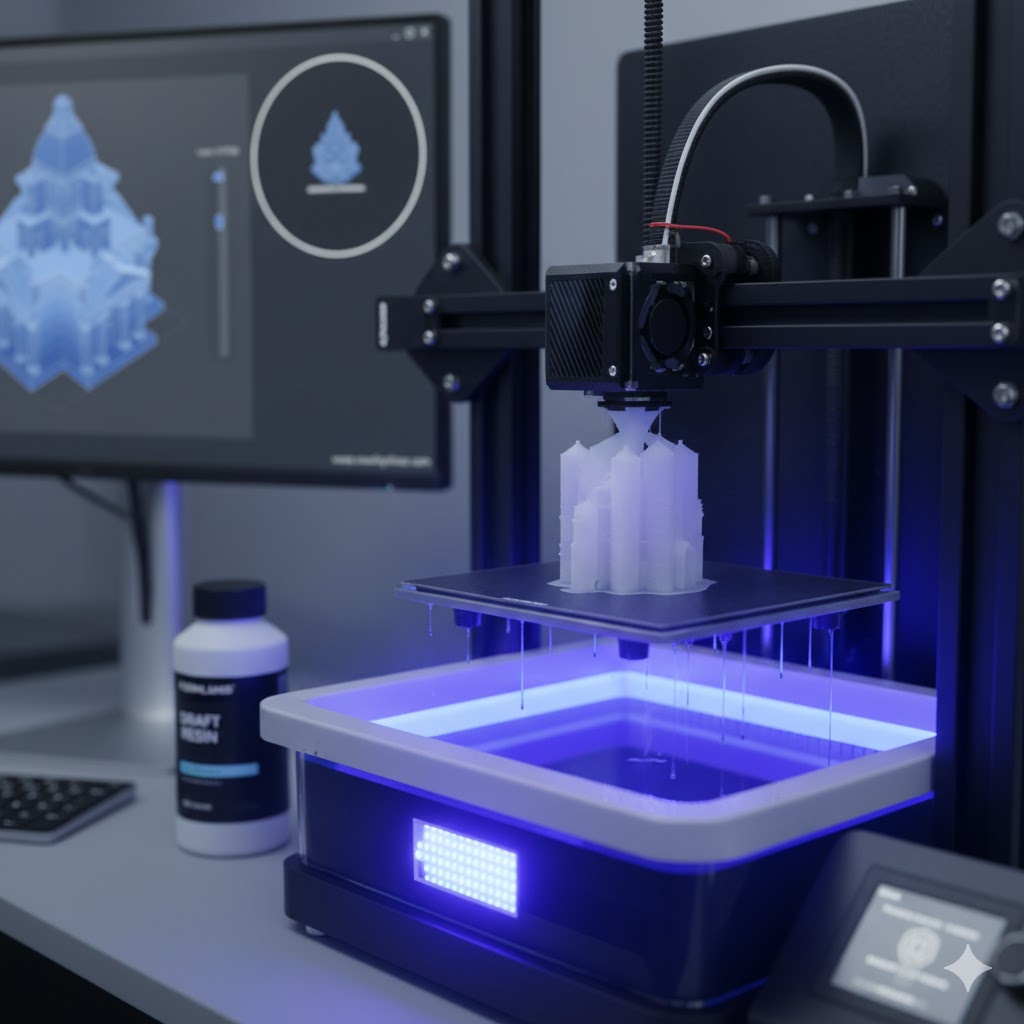
Resin 3D printing works through a process called photopolymerization, where liquid resin hardens when exposed to UV light. Unlike filament-based FDM printing, which extrudes melted plastic, resin printing cures an entire layer or pixel grid with precision, resulting in extremely fine detail.
- SLA (Stereolithography): Uses a laser beam to trace each layer, curing resin point by point. SLA delivers the highest accuracy, often down to 25 microns, making it common in dental, medical, and engineering industries.
- DLP (Digital Light Processing): Projects an entire image of a layer using a digital projector. This makes it faster than SLA while still maintaining excellent resolution.
- LCD/MSLA (Masked Stereolithography): Relies on an LCD screen with UV LEDs to mask each layer. It’s the most affordable resin technology, popular among hobbyists and small businesses.
The overall process includes layer-by-layer curing, lifting between layers, and finally, post-processing which involves washing the prints in isopropyl alcohol and curing them under UV light to ensure durability.
What Are the Types of 3D Printing Resin?
Resin comes in many formulations, each optimized for different applications. Choosing the right type depends on the mechanical, thermal, and aesthetic properties required.
- Standard Resin: Affordable and ideal for prototypes or display models. It produces smooth finishes but is brittle.
- Tough & Durable Resin: Engineered for impact resistance, often used in mechanical testing or functional prototypes.
- Flexible & Elastic Resin: Mimics rubber with high flexibility, used for seals, grips, and wearable parts.
- Dental & Biocompatible Resin: Certified for medical use, especially in orthodontics, crowns, and surgical guides.
- Castable Resin: Designed for investment casting in jewelry and dentistry, burns out without leaving ash or residue.
- High-Temperature Resin: Can withstand 200–230°C+, used in molds, tooling, and parts exposed to heat.
- Specialty Resins: Include ceramic-filled, bio-resins, and water-washable resins, offering unique advantages like eco-friendliness and simplified cleaning.
What Are the Advantages of Resin 3D Printing?
Resin 3D printing has become one of the most popular additive manufacturing methods because it delivers precision, smoothness, and versatility that filament-based printing cannot always match. Whether for hobbyists, engineers, or medical professionals, resin brings unique benefits that make it worth considering.
Exceptional Print Resolution and Detail
One of the biggest advantages of resin printing is its unmatched precision. With layer resolutions as fine as 25–50 microns, resin printers can produce intricate details that FDM printers struggle to achieve. This makes resin ideal for miniatures, jewelry, dental models, and highly detailed engineering prototypes. Small surface textures, facial features on figurines, or micro-scale components come out crisp and professional.
Smooth Surface Finish
Unlike filament printing, which leaves visible layer lines, resin printing delivers smooth surfaces straight out of the printer. This reduces the need for heavy sanding or polishing during post-processing. For industries like dental aligners or jewelry casting, a smooth finish is not just aesthetic—it’s functional, ensuring comfort and accuracy in real-world use.
Wide Range of Specialized Materials
Resin technology offers a broader spectrum of material properties compared to standard filament printing. Users can choose from:
- Standard resins for prototypes.
- Tough resins for impact resistance.
- Flexible resins that mimic rubber.
- Biocompatible resins for dental and medical use.
- Castable resins for investment casting.
This diversity allows resin printing to serve multiple industries, from healthcare to fashion design.
Ideal for Professional Applications
Resin 3D printing has become the go-to solution for industries where precision and certification are critical. Dental labs use resin to print crowns, bridges, and aligner molds with extreme accuracy. Jewelers use castable resin to create investment molds for gold and silver. Engineers rely on high-temperature and tough resins for functional prototypes. Its versatility makes it equally valuable for hobbyists and professionals.
Ability to Produce Complex Geometries
Because resin is cured by light rather than extrusion, it allows for geometries that would be difficult or impossible with filament printing. Thin walls, hollow structures, and intricate lattice designs can be achieved with high reliability. This opens doors for advanced product design, biomedical structures, and microfluidic devices.
Increasing Accessibility and Affordability
In the past, resin printing was reserved for industrial labs. Today, MSLA printers cost as little as $200–$400, making professional-quality printing accessible to hobbyists and small businesses. Combined with lower-cost resins and water-washable options, this has fueled a surge in popularity among creators and startups.
Faster Prototyping for Small Parts
DLP and MSLA technologies cure entire layers at once, meaning smaller parts can be produced quickly with outstanding detail. This makes resin printing highly efficient for rapid prototyping, especially when only small, precise components are needed.
According to a 2023 3D Printing Industry survey, 72% of dental labs rely on resin 3D printing for aligners and crowns due to its accuracy and biocompatibility.
What Are the Costs of Resin 3D Printing?
While resin delivers quality, it also comes at a higher expense than filament.
| Cost Factor | Hobby SLA/LCD | Professional SLA | Industrial SLA/DLP |
| Printer Cost | $200–$800 | $3,000–$10,000 | $50,000+ |
| Resin Cost | $25–$80/liter | $80–$200/liter | $150–$400/liter |
| Accessories | $50–$200 | $200–$1,000 | $1,000+ |
| Post-Processing | $50–$300 | $500–$2,000 | $5,000+ |
This shows why resin printing is sometimes called “the expensive cousin of FDM printing”, the consumables and cleanup gear increase long-term costs.
What Are the Hidden Costs of Resin Printing?
- Post-Processing: Prints require alcohol cleaning, UV curing, and sometimes sanding.
- Waste: Failed prints and uncured resin waste materials.
- Protective Equipment: Gloves, masks, and ventilation systems are necessary.
- Consumables: Resin vats and FEP films wear out and need replacement.
How Safe Is Resin 3D Printing?
Resins are chemical substances that require safety measures:
- Always wear nitrile gloves when handling resin.
- Use eye protection to avoid splashes.
- Ensure good ventilation, as fumes can irritate lungs.
- Dispose of resin waste properly, cured resin is safe, liquid resin is hazardous.
Many modern resins are being reformulated as eco-friendly, low-odor, and water-washable, reducing risks for hobbyists.
What Are the Limitations of Resin 3D Printing?
- Cost: Resin and accessories are more expensive than filament.
- Toxicity: Requires protective handling and careful disposal.
- Print Size: Most resin printers have small build volumes.
- Durability: Standard resins are often brittle compared to FDM plastics.
Resin vs Filament: Which Is Better?
| Factor | Resin Printing | Filament Printing (FDM) |
| Detail | Extremely high (25–50 microns) | Moderate (100–200 microns) |
| Surface Finish | Smooth, professional | Layer lines visible |
| Cost | Higher (resin + post-processing) | Lower |
| Build Volume | Small | Large |
| Strength | Brittle (unless tough resin) | Stronger with ABS, Nylon |
| Applications | Dental, jewelry, miniatures, engineering | Prototypes, functional parts, large models |
When Should You Use Resin Printing?
Resin printing is not always the best choice for every project. It shines in specific situations where detail, precision, and surface quality are more important than print size or mechanical strength.
- Miniatures and Models: Resin printing is the gold standard for tabletop miniatures, collectibles, and highly detailed figurines.
- Dental & Medical Applications: From orthodontic aligners to surgical guides, resin’s precision and biocompatibility make it essential in healthcare.
- Jewelry and Casting: Castable resins simplify the investment casting process, producing intricate patterns with smooth surfaces.
- Engineering Prototypes: When testing complex geometries or surface details, resin prints outperform FDM due to their fine resolution.
- Design and Product Development: Resin printing is best when appearance and detail matter more than durability—such as client presentations or design mockups.
If you need large, durable, or structural parts, FDM may be more practical, but if you need small, precise, and smooth parts, resin is the right choice.
Final Thoughts: Is Resin 3D Printing Worth It?
3D printing resin delivers unparalleled detail and versatility, making it indispensable for industries like healthcare, jewelry, and product design. However, it is more expensive and requires careful handling compared to filament-based printing.
For hobbyists, it offers unmatched quality in small models, while for businesses, it provides a professional edge in prototyping and production. With prices falling and eco-friendly resins emerging, resin printing is becoming more accessible than ever.
In short: Resin 3D printing is not the cheapest option, but it is the best choice when precision and detail matter most.

Hi, I’m Mark Stevens. I love exploring 3D printing and diving deep into slicer software. I spend my time testing slicer settings, comparing features, and sharing tips to help creators get smoother, faster, and more reliable prints. My goal is to make slicer tools easy to understand and use, whether you’re a beginner or a seasoned 3D-printing enthusiast.


